Showing posts with label Brakes. Show all posts

Thursday, July 18, 2013

In-Between Posts

This is work I did between the shop nights of 2/14/13 and 2/21/13:

Because my notes are sketchy, I'll summarize by saying it looks like I spent the week talking to people whose advice I respect about the condition of this lightened flywheel and seeing if they had a lead on a 9" flywheel.

I ended up getting a used (good core, or possibly make-do condition) 9" pressure plate from my uncle, and my friend B thought he found the correct 9-1/2" pressure plate (1949-50 Lincoln? Truck?) to fit the pre-'49 throwout bearing snout.  I found a flywheel at SF Flatheads/So-Cal Speed Shop Sacramento that is drilled for 9", 10", and 11" and looks just like my 9-1/2", so it might be a viable option.

Lastly, I made an unsuccessful visit to a local industrial hardware supplier to see if they had any clevises I could use for the brake pedal arm to master cylinder linkage.  Alas, they did not (in fact, the first counter jockey didn't even know what a clevis is!) but the second parts man correctly recognized the part I had in my hand (the threaded rod with an eye at the end) as a brake/M/C rod (although he guessed VW or early Porsche.  I got to talking with him and discovered that he builds sprint cars, drag motors, and does car builds/restorations.  I made sure to get his name and number for possible future fabrication work with my original go-to guy is gone (retired, as I've heard).

Also, during this week (although it might've been later as I'm writing all of these several months after I took my working notes) I got from my uncle several brake rods (mechanical) and clevises to use for the brake and clutch linkages.

-30-

Valentine's Date?

I wasn't very consistent when I was drafting these posts.  I might've done this work on 2/14/13 and drafted this on 2/21/13 or I might've done the work on 2/21/13.  I know we worked Valentine's Day as my wife and I postponed our date to avoid the crowds and expense of the holiday.  Nonetheless, my notes are sketchy enough that it's a brief post.

It appears that this night we drilled out to 3/8" the mounting holes (I originally had 5/16") for the master cylinder (a '39 Ford-type) on the Tardel mounting bracket that I had made from the drawings in his (and Mike Bishop's) book.  Despite my wanting to purchase all original style Ford bolts from this supplier, W insists in the interest of cost and ease of assembly (coarse thread (UNC) being faster to start and tighten than SAE (fine thread)) that we just use hardware from the local hardware and big box stores.  And seeing how he has become our parts runner (going out and buying hardware for which I reimburse him), how can I argue with him?  The cost is a good factor, but I sure appreciate not futzing around with "just the right bolt" when we can have it assembled that night.

We also took a look at the 9" flywheel on my other flathead to discover, in W's words: "some damned hotrodder's lightened this thing!"


Not sure it will work, but I'm still coming up dry looking for a 9" flywheel elsewhere.

-30-

Sunday, July 14, 2013

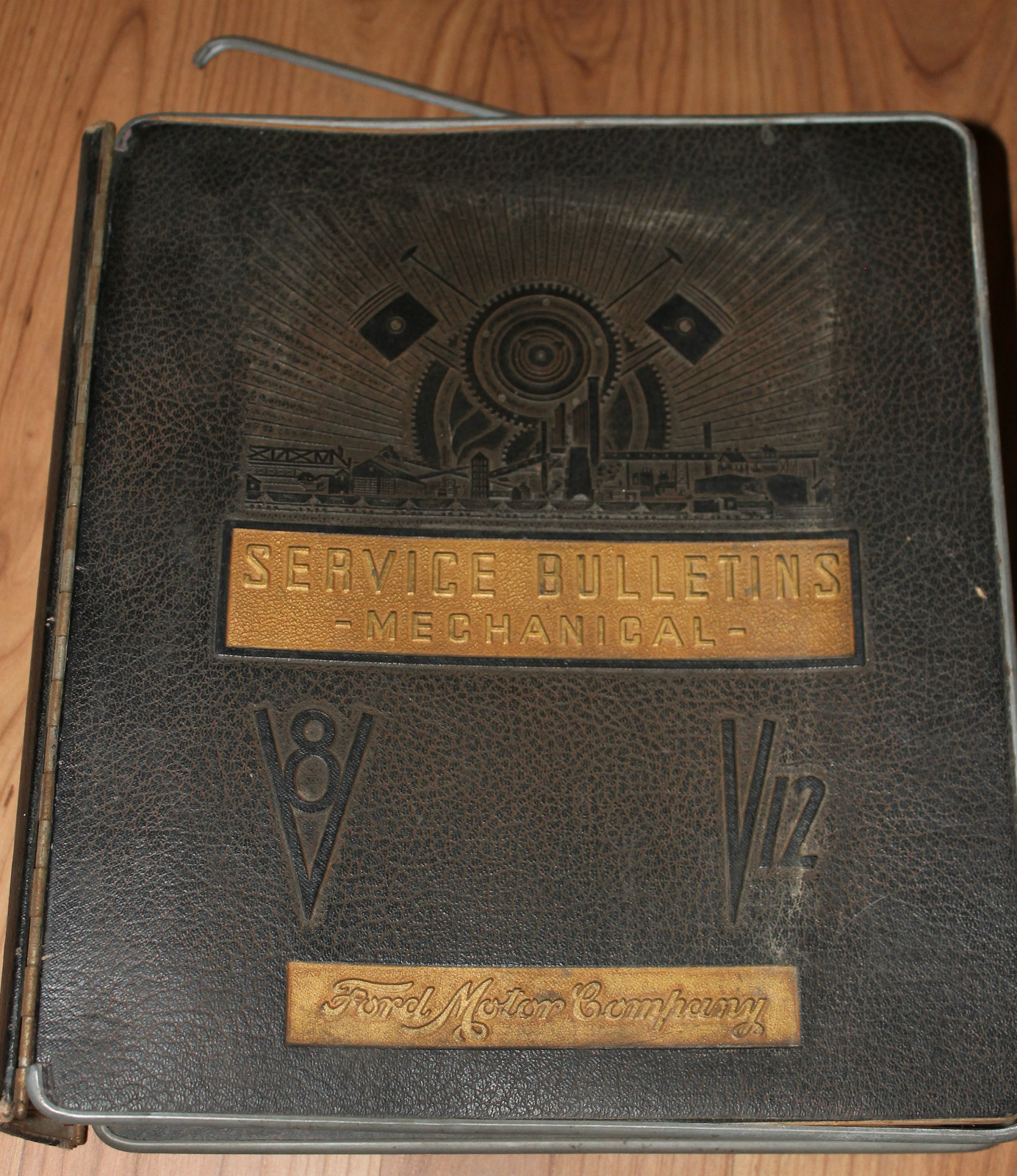
Early Ford V-8 Service Bulletins


This was meant to be essentially a notes post for myself, to record the tags/labels/whatever Blogger wants to call them now, that I'll begin tagging and, eventually, go back and retag my old posts for easier topical searches.

I have recorded below the categories or binder tabs found in early Ford V-8 Service Bulletins (also used in the Model A era, maybe Model T, too - I'm not sure.  In searching for a link for the previous sentence, I was surprised how little I found on this topic outside of eBay listings.  If you ever get a chance to see/borrow/scan/buy an original set of these service bulletins, do not pass up the chance!  The repros are great, and I have a couple of sets, but the originals are priceless because of their size, clarity, and the tactile feedback you get from the (cotton-based?) paper and history they ooze.

Anyway, the bulletins were issued to Ford mechanics to update/illustrate/educate them on running changes to Ford parts and services, including some of the new, gee-whiz things like hydraulic brakes and overdrive (Lincolns) and are invaluable nowadays to understand the how and why of Ford parts when most of the original old-timers are gone.

Binder Tabs:

Service Management
0 – 999
Wheels & Tires
1000
Brakes
2000
Front Axle & Steering
3000 / 3500
Rear Axle & Torque Tube
4000
Frame, Exhaust Springs
5000 / 5300
Engine
6000
Transmission & Clutch
7000 / 7500
Cooling System
8000
Fuel System
9000
Electrical/Ignition System
10000 – 15999
Fenders - Shields
16000 – 16999
Accessories
17000 – 19999
Body & Paint
70000
Interior & Top
A-1
Control Systems
C-1
Specifications
S-1
Inspirations/Aspirations
X-1

-30-

Thursday, February 21, 2013

2/21/13: Pedaling Along


Tonight we (perhaps) finished drilling all of the 3/8" bolt holes to mount the master cylinder bracket to the frame, and the master cylinder to the bracket.  The bracket I have (that I built from plans in the Bishop/Tardel book) is designed to mount using (presumably) factory '32 pedal assembly and K-member holes.  Well, I'm using a '33-'34 pedal assembly and a Tardel K-member for the Model A frame, so we had to drill all but one of our mounting holes (by step drilling from 1/8" or so) and opened up to 3/8" the holes for the master cylinder (for strength).  This was tedious (a 64th or so at a time) and resulted in several broken bits (from my ancient set of no-name bits).  Several times, to keep us going, W repointed dull or not-so-badly broken bits on the bench grinder.

After doing that, we took a look at the swing for the clutch pedal and determined it will hit the firewall before full travel.  So, we marked the trouble spot (ended up being not just a notched-out section, but a short strip down the firewall) and cut horizontally at the top with the hack saw (just an aside, the hack saw is becoming one of our favorite go-to tools - it's fast, and quiet, which is great at 10 o'clock at night).  We then used vice grips and a small block of metal to clamp at the vertical cut line and just bent back and forth until we broke the section free.

Pedal interference with the firewall

Marked for removal

Cut and bent out (first section)

Removed the whole section to avoid problems

Finally, to hook up the clutch pedal to the transmission release arm (one that we selected because it seemed to provide the best alignment and most travel against the transmission case; I don't know what year it's from), W and I both were thinking along the same lines in our separate, late night reveries: we both independently went out and bought some small turnbuckles and threaded rod and some OK clevises - although too small, it turns out.  The turnbuckles were a bust - they are too small or too big and have too much slop in them.  The threaded rod would work if we had clevises the right size: 5/16" or 3/8".

Clutch adjustment rod mock-up (with master cylinder rod)

In looking at my Ford parts catalogs, it turns out there was a 5/16" clevis used on Model As that seems just right.  I don't recall immediately what the application or part no. is, but I think it was for brakes.  [Note: found it; yes, mechanical brake clevis up to 1938 - 97012-S]  Later clutch adjustment clevises are 3/8", which seems too large.

Lastly, this week (and, as I write this post hoc, subsequently) W gave me some cool old (and random) hardware from his garage, some in ancient tin cans like Hollywood Shave Cream and Yan Chim Kee Cocoanut Flavored Candies.  Problem is, I don't have a good hardware storage system as it is, so additional stock, while appreciated, is just more stuff that I need to find a home for.

-30-